
There is no digital sovereignty without the printed circuit board (interview in AV Elettronica)
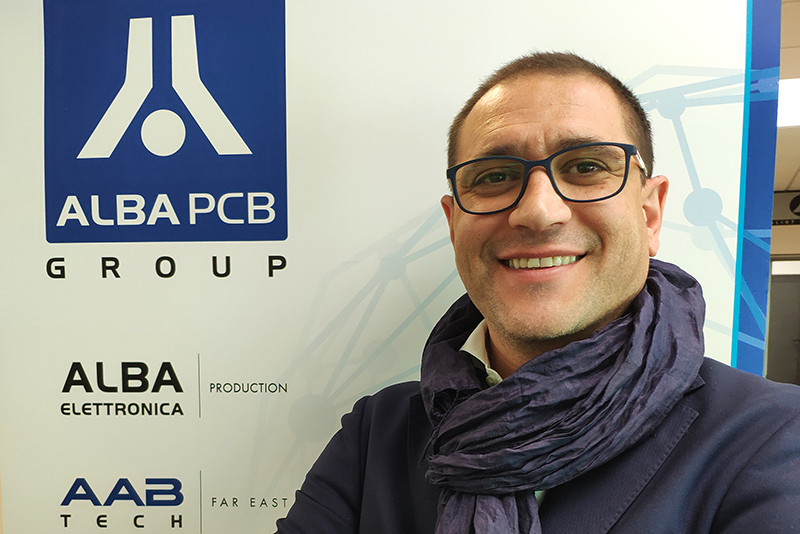
Article from AV Elettronica, issue no. 39, by Laura Reggiani
Fabio Puccia Modica, Chief Commercial Officer of Alba PCB, shakes up European industry: ‘We are investing billions in silicon, while forgetting the body that supports it.’
For years, the printed circuit board remained outside the public debate on innovation. Invisible, taken for granted, relegated to a cost item in procurement spreadsheets. Yet today, in the midst of Europe’s race for technological sovereignty, that very ‘piece of fiberglass and copper’ risks becoming the real bottleneck of advanced electronics. While Brussels invests billions in semiconductors and major OEMs talk about reshoring and resilience, the PCB supply chain continues to exist in a grey area: strategic in practice, ignored by industrial policy.
It is a paradox that risks undermining every ambition for the continent’s digital autonomy. We discussed it, without mincing words, with Fabio Puccia Modica, Chief Commercial Officer of Alba PCB Group and a privileged observer of a sector he knows from the inside. What emerges is a clear, at times uncomfortable analysis that challenges established dogmas: from the myth of ‘lowest cost’ to dependence on Asia, from the role of procurement to the shortsightedness of European institutions. More than an interview, it is an open letter.
And one question remains hanging: can we really talk about digital sovereignty without controlling the physical infrastructure on which electronics rests?
For years, the PCB was regarded as a commodity. Is that era really over?
For decades, we treated it as a ‘commodity’: a flat sheet of fiberglass, copper and chemicals to be purchased at the lowest possible price, preferably in a container arriving from Asia. But today, anyone sitting at the tables where the future of electronics is being decided—from AI servers to next-generation automotive—knows that the music has changed. The printed circuit board is no longer an accessory. It is the critical link, the strategic infrastructure that enables the system. And yet, while Europe mobilizes through the European Chips Act, it seems to have forgotten one fundamental detail: a chip without a package and without a PCB is not a system; it is merely a useless piece of silicon.
Are you saying that European industry is taking the wrong approach?
The PCB is a strategic asset, not a unit cost. We need to say this clearly: the ‘lowest-cost wins’ logic has been killed off by the semiconductor crisis and geopolitical tensions. Value has shifted dramatically from cost per unit to technological capability and
supply-chain reliability. Today, growth is no longer measured in square metres, but in technological density. We are talking about HDI (High Density Interconnect), advanced substrates, and rigid-flex for 800G networks. It is a ‘premium’ market in which Europe, although marginal in mass-market volumes, still maintains excellence in high-value niches such as aerospace, defence and power electronics. But how much longer can we hold out if we do not reverse our political course?
How dangerous is the dependence on Asia that everyone talks about, but few seem willing to address?
Our dependence on Asia is almost total. We are not talking only about the physical production of the circuit board, but about its very foundations: copper, glass fibres and high-speed laminates. The concentration of production in China, Taiwan, Japan and Korea creates a geopolitical risk that no strategy can truly mitigate. We are facing a paradox: Europe invests billions in silicon, but neglects the ‘body’ that has to host it. If we really want to talk about technological sovereignty, we must include PCBs in European industrial policy. It is impossible to guarantee European sovereignty in semiconductors without European manufacturing capacity in printed circuit boards.
Procurement, however, still reasons almost exclusively in terms of price. Who needs to change?
I believe we need a call to arms for strategic sourcing. Procurement must evolve. We can no longer afford to involve the PCB supplier only downstream of the design phase. The model must be integrated Design for Manufacturing, with the PCB manufacturer entering the process already at the design stage. In this scenario, the transition towards a Strategic Redundancy model is no longer merely an option, but an imperative to safeguard Europe’s technological autonomy in the face of production concentration in China. It therefore becomes essential to secure the supply chain through a nearby European partner for prototyping and production, while at the same time integrating qualified and independent channels for cutting-edge technologies.
If you could speak directly to Brussels, what would you ask for?
I would propose a Manifesto for European Electronics. If we want to preserve the know-how of our engineers and the resilience of our factories, we need concrete action, not just market analysis. In my view, these are the key points:
• extend the Chips Act to the PCB supply chain, encouraging investment in HDI technologies and substrates;
• ensure competitively priced energy, because PCB production is energy-intensive and, without controlled energy costs, the competition with Asian giants is lost from the outset;
• implement tax credits and incentives for companies investing in automation and sustainability in Europe;
• protect critical materials and guarantee access to Western-produced laminates, copper foil and glass fabric.
To conclude, why should an OEM choose Europe today, against every cost-driven logic?
Europe does not compete on volumes, but on ‘trust’. Traceability, data security, protection of intellectual property and regulatory compliance: this is our added value. It is time to stop looking at the price list and start looking at the geopolitical map and the technology roadmap. The PCB is the infrastructure on which the continent’s digital future rests, and it is time to treat it as such!
Inne posty
Zarządzanie Środowiskowe: Alba Elettronica uzyskała certyfikat ISO 14001:2015
Alba Elettronica z przyjemnością informuje o uzyskaniu certyfikatu zgodności z normą UNI EN ISO 14001:2015...
Przeczytaj więcej
PCB: ciągłość dostaw staje się czynnikiem decydującym. Alba PCB Group potrafi to zapewnić
Sytuacja rynkowa: złożony proces zaopatrzenia Branża obwodów drukowanych przechodzi obecnie okres gwałtownych zmian. Dynamiczny rozwój...
Przeczytaj więcej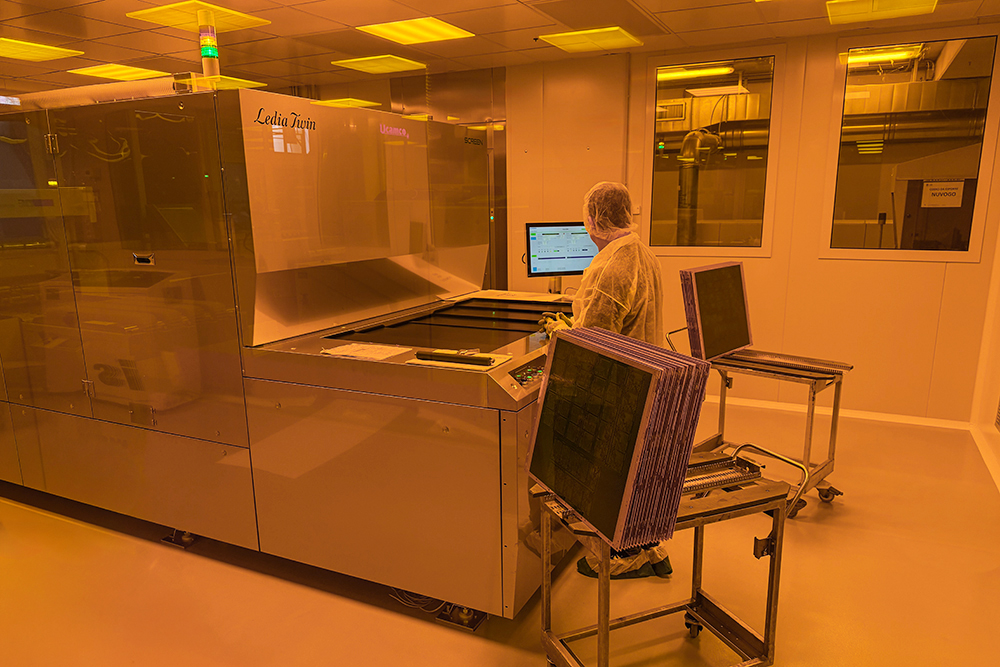
Włoski zakład produkcyjny: drugi System Direct Imaging w żółtym pokoju (cleanroom)
W naszym zakładzie produkcyjnym w Mogliano Veneto uruchomiliśmy drugi żółty pokój (cleanroom) klasy 10 000...
Przeczytaj więcej